
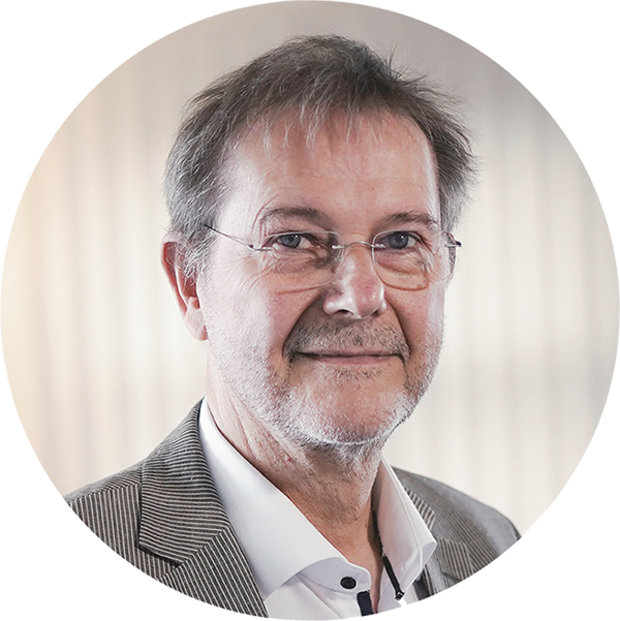
Dear students, colleagues, partners, and friends of the IPU,
Another eventful year is behind us. It demanded a great deal of effort from all of us, but thanks to the diverse initiatives and tremendous commitment of our faculty, academic and administrative staff, and our students, it was a very successful year. In this year in review, I can of course only highlight a few of the many highlights, and the selection is difficult for me.
Promoting young talent and doctorates at IPU Berlin
The most important thing is certainly the right to award doctorates, which the Berlin Senate Administration granted us in March of this year after the successful reaccreditation of our university (applied for early in 2024). This was met with great enthusiasm in the academic world and beyond, because the – rightly – high requirements of the German Science and Humanities Council (Wissenschaftsrat) for the right to award doctorates for non-state universities cannot be compensated for with performance alone, but require a long-term program that has been thought out in detail, a convincing research profile, a concept for promoting young talent and proof of adequate structures. The IPU has convincingly demonstrated that it meets these requirements. In the meantime, the doctoral committee headed by Prof. Christine Stelzel has redesigned the application and admission procedure for doctoral studies, an independent doctoral program is in the planning stage and the first doctoral procedure was recently opened, which will be completed at the beginning of the new year.
Of course, the IPU has actively supported doctoral studies in the past as part of its efforts to promote young talent, particularly within the framework of the IPU/KKC graduate college and the IPU doctoral college – often supported by doctoral scholarships from the Foundation for the Promotion of University Psychoanalysis and by the Hans Kilian and Lotte Köhler Center for Social and Cultural Psychology and Historical Anthropology at the Ruhr University Bochum (KKC). However, the procedures themselves still had to be carried out at cooperating universities. Among the doctoral theses of 2025, the award-winning dissertations by Johanna Klinge and Simon Kempe are particularly noteworthy.
However, promoting young talent starts earlier. As every year, we also awarded prizes for the best theses in 2025, this time to Lara Ebner (bachelor's) and Salome Joubert (master's). In this context, it is also worth mentioning our new website Young Scholars.
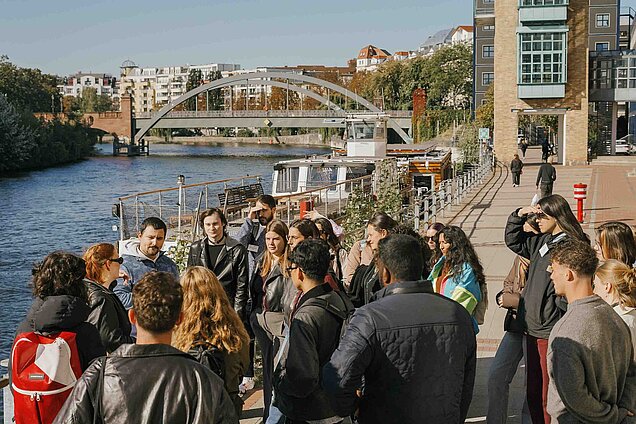
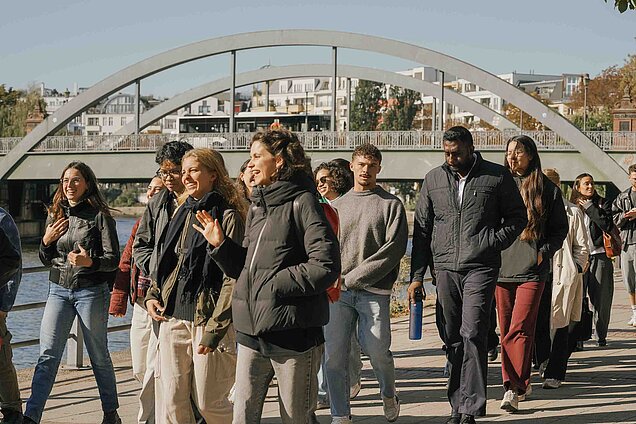
Die IPU ist stolz, die ersten Studierenden des innovativen Erasmus Mundus Joint Master SPOT bei sich begrüßen zu dürfen. Zum Start des Wintersemesters 2025/2026 wurden sie vom International Office der IPU willkommen geheißen. Auch im nächsten Wintersemester wird der Studiengang wieder starten. Interessierte können sich bis zum 16. Januar 2026 bewerben.
New degree programs
In the fall, we once again saw an increase in student numbers, particularly in the (new) Master's program in Psychology and in the international Erasmus Mundus Master's program Social Psychology of Transformation (SPOT), which was launched on 29 September with an IPU Welcome Week in collaboration with a consortium of six European universities, coordinated by the IPU. Twenty-nine students are enrolled here, which means that the program is at full capacity. Our master's program in Psychoanalysis and Cultural Psychology in Contemporary Societies which was designed as a full-time program with a new focus, began in the fall and was set up in close cooperation with the KKC. Its reaccreditation is nearing completion. The work of the Germany Scholarship thematic classes also continued in 2025, including an event organized by the scholarship holders themselves on the topic of "AI and Psychoanalysis: Exploring the implications of artificial intelligence for psychotherapeutic practice" on 22 October.
The KKC will move entirely to IPU Berlin on 1 January 2026. Intensive preparations for the transition have been underway throughout the year, and many of the KKC formats and events have already been gradually transferred to our university.
Research
The IPU made particularly good progress in 2025 in terms of acquiring third-party funding. Several new research projects approved by renowned funding institutions testify to the climate at the IPU, which enables and encourages concentrated scientific work. The projects for which six-figure sums were approved as of 1 January 2025, alone make for an impressive list. It ranges from the project The association between self-regulation facets and internalising symptoms in the course from middle childhood to emerging adulthood (DFG, Prof. Annette Klein) and The age-prospective memory paradox revisited (DFG, Prof. Christine Stelzel) to Young People in Remote Regions (Volkswagen Foundation, Prof. Phil C. Langer) to the recently acquired project Negative therapist behavior in the treatment of personality disorders (DFG, Prof. Christian Sell). At the same time, there are other third-party funded projects with large sums of money, funded jointly with renowned cooperation partners, which were already approved in the previous two years, such as PLEDGE: Politics of Grievance and Democratic Governance (European Research Executive Agency, Prof. Gavin Sullivan) or Treatment Integrity and Mechanisms of Action in STAIR-Narrative Therapy and Trauma-Focused Psychodynamic Therapy (both ENHANCE network, BMBF, Prof. Christiane Steinert), to name just the six-figure funded projects.
Overall, the IPU Berlin currently manages a third-party funding volume of around €13.5 million over several years, with the major projects of the European Union (Erasmus Mundus), DAAD (Promotion of international talents for integration into studies and the labour market, FIT) and the Karl Schlecht Foundation, the German Research Foundation (DFG) with its strict funding criteria is at the top of the list.
In addition to the Erasmus Mundus Joint Master's Program SPOT and Erasmus+ with EU countries (as well as Bosnia-Herzegovina), IPU's International Office has also raised considerable sums, also in the six-figure range, from the DAAD with the programs FIT and PROMOS (international mobility) and STIBET (combined scholarship and support program). In addition, it was once again very successful in organizing international student exchanges this year. Partner universities, especially those in the SPOT network, were visited and guests from there were welcomed. In May, Yuliya Salauyova and Annett Seifert also attended the Annual Conference & Expo of NAFSA in San Diego (NAFSA: Association of International Educators, originally National Association of Foreign Student Advisers).
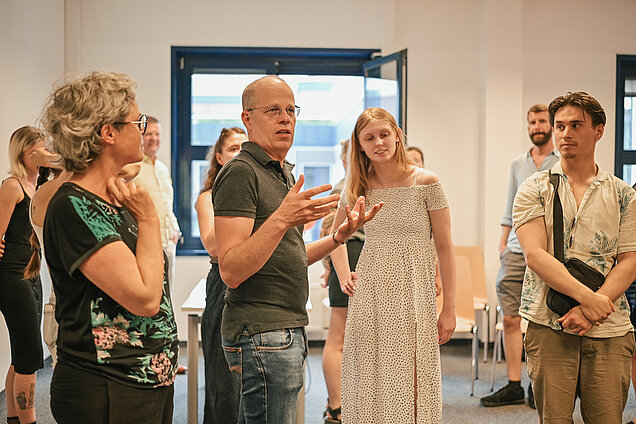
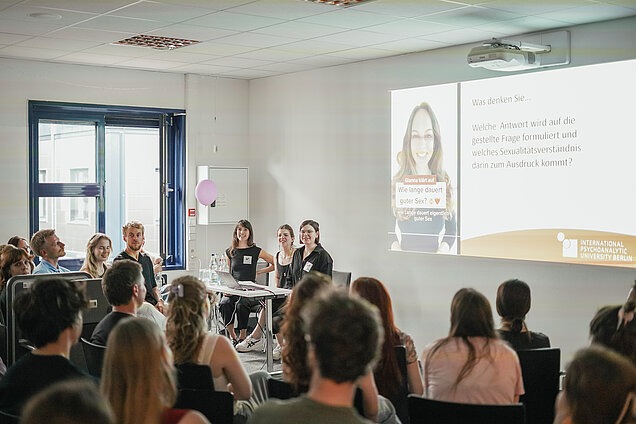
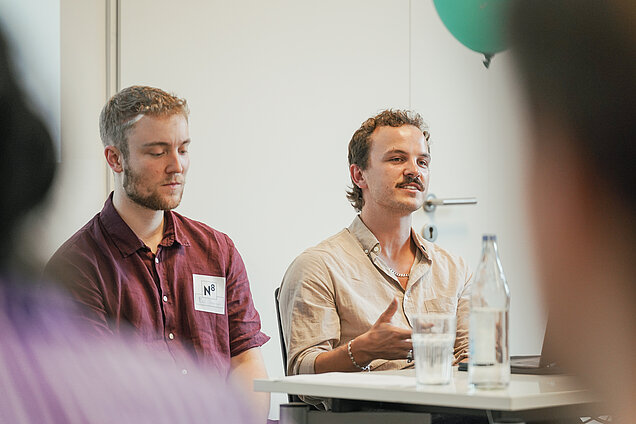
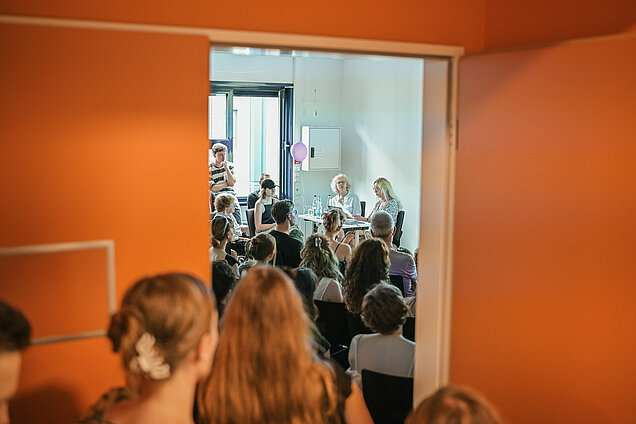
Eindrücke von der diesjährigen Langen Nacht der Wissenschaften. Zusammen mit den Berliner psychoanalytischen Instituten bot die IPU Berlin ca. 1.000 Gästen ein vielfältiges Programm. Die nächste LNDW wird am 6. Juni 2026 stattfinden.
Conferences and symposia
First and foremost under this heading is, of course, this year's annual conference, which we designed as a Forschungslabor plus. It served as an interim review of our research program, with which we had successfully applied for the right to award doctorates. The event kicked off on 26 November 26 with a public evening lecture by Prof. Vera King (SFI Frankfurt am Main), who spoke on the topic of Psyche and Society in Times of Regression: Perspectives of Psychoanalytic Social Research. The following morning, projects from our three main areas of focus (psychotherapy research, concept research, transformation research) were presented, followed in the afternoon by contributions from doctoral students, also based on the main areas of focus. We received suggestions for the further development of the research profile from the Scientific Advisory Board, which met afterwards.
The conference Interwoven: Subjects Beyond Autonomy and Dissolution, organized in collaboration with the Green IPU, deserves special attention. Groups of research assistants and students played a key role in planning and preparing this event.
Further highlights included the Junktim annual conference on 14-16 March on the topic of "Emotions in the treatment room – within me or between us?" and the interdisciplinary symposium of the IPU-KKC graduate college "Violence – Subjective Experiences in Collective Relationships".
Annual events, some of which took place several times a year, included the Research Day for students on 16 January, the graduation ceremonies on 17 January and 20 June, study information days and evenings on 30 January, 12 June, 4 September and 20 November, the semester kick-off events on 11 April and the opening of the academic year on 15 October (here with Eckehard Pioch). In addition, there were the Career Days from 3-5 July, the anniversary celebration on 15 October (which focused on Kerstin Thesenvitz, head of the team finance and personnel, celebrating 15 years with the IPU), and the Doctoral Student Day on 12 November. On 12 February, 29 April and 5 November, the works council invited us to works meetings and on 11 December we had our Christmas party, which Johanna Steuber and her team had prepared in a delightful way.
Lectures, panel discussions, podcasts
There are numerous lectures and panel discussions with renowned speakers, both as individual events and as part of series, which can only be reported on here using selected examples. These include the public lecture series Theoretical and Historical Aspects of Psychosis with the closing event MUTTiER III: When Words Fail. Children and Psychosis, the Emergence of Language and Art from Fear on 26 September, the series Psychoanalysis and Dance Studies in cooperation with City Kino Wedding, the audio series Understanding the Unconscious (Das Unbewusste verstehen), the panel discussion Power and the Public Sphere: Media Criticism and the Humanism of Erich Fromm and the event Historical Psychoanalytic Analysis of Current Jewish Voices in Germany: After the Break.
On 25 June, the annual Thomä-Kächele Memorial Lecture took place, to which we invited Juan Pablo Jiménez (Chile), who spoke on the topic Psychoanalytic and scientific progress is achieved through relationships between people and on 10 December the Erich Fromm Study Center invited Neil McLaughlin (Canada) to give this year's Erich Fromm Lecture Public Psychoanalysis for today – Why Erich Fromm matters.
A special highlight on November 19 was the reading and discussion "A Language of Love – On the Interspecies Communication of Horses and Humans at the Intersection of Psychoanalytic Theory and Treatment Practice," to which Benigna Gerisch invited the two authors of the book of the same name, Loretta Würtenberger and Hubertus Graf Zedtwitz, to a reading and discussion.
As part of a series of IPU-KKC lectures, Iris Därmann (HU Berlin) spoke on November 5 about "Networks of Female Resistance in Auschwitz", and on December 4, there was a lecture and discussion with author Hans Joas on the topic of "Universalism, World Domination, and Human Ethos".
In 2025, our communications team continued its popular podcast 50 Minutes (50 Minuten), for example in February on the topic of Why Anti-Semitism is Still Relevant Today with Prof. Christine Kirchhoff and Doreen Zeymer-von Metnitz, in June on Psychotherapy on TikTok with Marie-Luise Alder and Jenny Gergs, in July on "What you consider individual is culturally influenced" with Prof. Jürgen Straub and most recently in December on "Living fast and slow" with Sönke Behnsen.
Student initiatives
Numerous student initiatives accompanied us throughout the year, such as the spring lecture series of krIPU, which celebrated its 10th anniversary on 4 July, the Queer IPU lecture series trans* denken, the Geile Gala with book presentation and party at the Kulturfabrik and the already mentioned interdisciplinary conference Interwoven: Subjects beyond autonomy and dissolution in collaboration with the Green IPU. The commitment of many students to the EsBar, as well as the student party on 16 May, is definitely worth mentioning. We would like to take this opportunity to express our sincere thanks to the Student Council (StuRa), namely the two chairpersons, Julia Sinkowicz and Vincent Scharrer, for their consistently excellent and trusting cooperation.
Personnel developments
There have also been a number of personnel changes at our university over the past year. Ella Beate Deppe joined us in January as the new Chancellor and Managing Director of IPU GgmbH Berlin. As the successor to Rainer Kleinholz, she is a member of the university management team and heads up the administration, which means she is primarily responsible for personnel development, budget planning, and all other administrative processes. Several new employees (some in third-party funded positions) and replacements have joined the university to manage these areas, as well as in the areas of research and teaching, and I cannot list them all here by name.
At the beginning of the current winter semester, Thorsten Peetz took up his post as Professor of Organizational Research, and just recently, the hearings for the professorship in Clinical Psychology with a focus on behavioral therapy took place after the foundation and supervisory boards approved the position ahead of schedule. This is a key position for representing the IPU's openness and diversity of procedures, which we are confident we will be able to fill successfully by the 2026 summer semester. On the other hand, the endowed professorship in cultural studies failed due to the rejection of the top-ranked candidate. We are all the more grateful to the KKC, which is taking over and financing a substitute professorship for the regular professorship in psychoanalytic cultural studies and cultural psychology, which has not yet been approved.
On the other hand, we have had to say goodbye to some long-standing professors and staff members. The former include Prof. Andreas Hamburger, who has been one of the founding professors of the IPU since 2009 and gave his farewell lecture on 13 June on the topic of Psychoanalysis AND University, as well as Prof. Annette Streeck-Fischer, also a founding professor of the IPU, who retired on 17 October with a farewell symposium From Practice to Research in Analytical Psychotherapy for Children and Adolescents. Both have had a decisive influence on the IPU Berlin, whether in clinical psychology, trauma research, and film analysis, or in developmental psychology and the theory and practice of child and adolescent psychotherapy. The IPU Berlin owes them a debt of gratitude, and we are very happy to be able to continue to rely on both of them – now in the context of senior professorships.
Unfortunately, we also had to say goodbye (or will have to say goodbye soon) to Benjamin Duhs, our long-time IT manager (also with us since the beginning); previously, we said goodbye to Annett Seifert from the communications team, Rovena Biletzki, controller in administration since 2014 and Julian Reitzenstein-Kurz, head of our facility management. Katja Roth-Kroeckel (training and continuing education) and Johanna Steuber (Management and Organization) amongst others joined our administration teams in 2025. Excellent successors have already been found for the colleagues who are leaving our university, and they will start working at IPU at the beginning of the year.
What else is there to report?
We were particularly pleased in May when the latest results of the CHE Ranking 2025 were published and IPU achieved outstanding results (ahead of Humboldt University in the Berlin area).
On 28 June, IPU once again participated with its own program in the Long Night of Sciences (LNdW), which has been held in Berlin for 25 years now. Together with the Berlin psychoanalytic institutes, we offered insights into the scientific and clinical work of the university and psychoanalytic training.
The WIPU working group, led by Prof. Benigna Gerisch, has completed its work and the finished application has been submitted to the Chamber of Psychotherapists. Unfortunately, the political requirements for financing further training have not yet been clarified, so that all institutes are still puzzling over how to shoulder the costs of the new further training.
At the start of the winter semester, the third Freud display case was set up in the library, another building block for a future Freud museum in Berlin and the result of a seminar with, among others, researching the correspondence between Sigmund Freud and Arnold Zweig.
Since this year, social media has seen an increase in interesting video content that shares knowledge from research and allows students to share their experiences from various degree programs and projects at IPU. You can watch the videos on our Instagram channel, on YouTube, and, since this summer, on IPU's TikTok channel.
Almost incidentally, we also managed to move from House 1 to House 3b, even if we had to squeeze in a little. Julian Reitzenstein-Kurz and his team managed this complex undertaking with expertise and determination, for which they deserve our sincere thanks. A few minor adjustments still need to be made, but it would not be a good sign if the IPU were unable to move "walls" (otherwise always mountains) for once...
Therefore, I would like to once again express my sincere gratitude to all my colleagues, the research assistants, the hard-working members of the administration, our students and doctoral candidates, and our cooperation partners, only a few of whom I have been able to mention by name here. Thanks in no small part to their commitment to the IPU, we have every reason to look forward to the new year with confidence and joy.
Outlook
Preparations have already begun for the IPU Annual Conference 2026 on Artificial Intelligence in Psychodiagnostics and Therapy (working title), and there are also initial proposals to extend cooperation within the framework of the international Erasmus Mundus Master's program SPOT to research. The Office for Studies and Teaching is facing new challenges in process management, and we also need to make progress in the area of digitalization (including the implementation of the new campus management system). At the same time, the strategy discussion on the future of the "small" degree programs must be continued, as must the work of the working group on the redesign of the English-language Master's program in Psychology. In addition to the further expansion of marketing, the development of new sources of income will be an important strategic focus in 2026.
Last but not least, the transition to a new university management presents a number of challenges that must be overcome in the best possible way. Thanks to the great commitment and diverse initiatives of the members of all groups, the IPU is stable and well positioned to address all these issues. The university management would like to take this opportunity to express its sincere thanks and wish you all a blessed Christmas and much happiness and success in the new year 2026.
Prof. Jan-Hendrik Olbertz
(President)