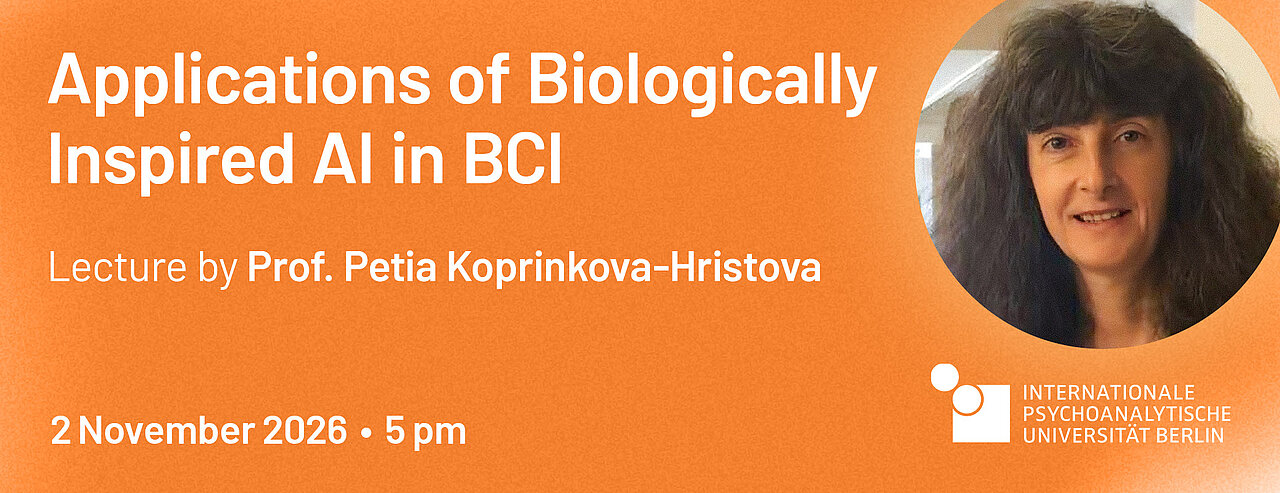
Applications of Biologically Inspired AI in BCI
A lecture by Prof. Petia Koprinkova-Hristova (Institute of Information and Communication Technologies, Bulgarian Academy of Sciences)
The lecture will present current experience of the IICT team on development of Brain-Computer interface (BCI) using biologically inspired models of Artificial Intelligence (AI).
The models were developed during the HORIZON-EIC action under the project “Auto-adaptive Neuromorphic Brain Machine Interface: toward fully embedded neuroprosthetics (NEMO-BMI)”.
The project aims to decode the movement desired by a tetraplegic patient. The brain signals were recorded by electrocorticographic (ECoG) implant from the motor cortex area of the patient’s brain. The decoder receives the signals from 64 electrodes in blocks of approximately 100 milliseconds each. The biologically inspired decoder consists of two building blocks: a 3-dimensional neural network composed by biologically realistic spike timing neurons (3D SNN) that accounts for time and space characteristics of the brain signals and a recurrent neural network with a randomly generated pool of neurons inspired by the neocortical networks. Both modules have auto-adaptive abilities so the decoder is able to adapt in real time to the variability of the incoming brain signals.
The future aim of this research is to embed the neuromorphic decoder into some of just appearing on the market neuromorphic hardware devices. Preliminary tests on Intel’s Loihi and SPiNNaker2 clouds proved applicability of our model on such devices. This will allow to the decoder to work in real time with low energy consumption.
The Lecturer
Petia Koprinkova-Hristova received MSc degree in Biotechnics from the Technical University - Sofia in 1989 and PhD degree on Process Automation from Bulgarian Academy of Sciences in 2001. Since 2003 she wass Associate Professor in the Institute of Control and System Research and from January 2012 - in the Institute of Information and Communication Technologies (IICT), Bulgarian Academy of Sciences. She became full Professor in Informatics and Computer Sciences in November 2019. Her main research is related to applications of Artificial Intelligence in various fields. Her expertise is in reinforcement learning, spike timing neural networks and recurrent neural networks. She was elected member of ENNS executive committee for 2011 - 2019. She is currently a member of IFAC Technical Committee on Computational Intelligence and Bulgarian representative in the IFIP Technical Committee on Human-Computer Interaction.