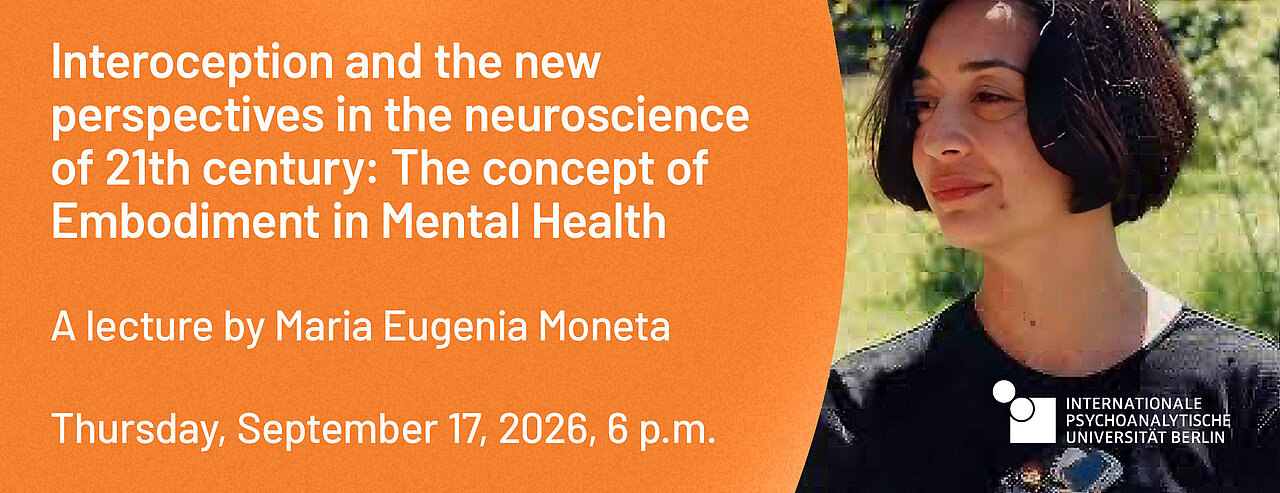
Interoception and the new perspectives in the neuroscience of 21th century: The concept of Embodiment in Mental Health
A lecture by Maria Eugenia Moneta
We warmly invite you to this lecture on Interoception, the missing link between brain, body and mental health. It's about how the brain senses the body from within: the brain´s ability to detect, interpret and respond to signals coming from the body. We will discuss some topics about Body feeling and sensations during Psychotherapy interventions. The body is behind the scene.
Those signals from the body allow to feel and sense when we are hungry or thirsty and other physiological signals. Every moment the brain receives information from the organs of the body and muscles and autonomic nervous systems, these signals help to create a body state which is personal.
Regions such as the insula, anterior cingulate cortex, brain stem, play key role in processing interoceptive information, these networks help to integrate physical and emotional experience.
Individuals vary in his capability to experience the body and interpret bodily signals. These differences can influence emotional regulation, resilience and mental health, including chronic pain. Resilient people have more capacity to regulate chronic pain and discomfort. Why is that?
The Lecturer
Maria Eugenia Moneta, PhD, Studies of Biology and Psychology at the Universidad de Chile, Santiago, Master of Sciences, 1974
1990 Dr. human Biol. Faculty of Medicine. LMU Universitaet Muenchen.
Positions
Instructor, Assistant Professor at Medical Faculty- Universidad de Chile until 2018 (with interruptions).
Fellow Max Planck Gesellschaft
Institute for Brain Research, Frankfurt from 1984 to September 1985.
Invited researcher at the Department of Physiology, Universitá degli Study di Milano 1985-1986. (Sleep research)
Research Associate at the Faculty of Medicine, Physiology section, Ludwig Maximilian Universitaet Muenchen 1987-1990
1990 Dr. Human Biol. Faculty of Medicine, University of Muenchen. Thesis:” The kindling model of experimental epilepsy and plasticity in the nervous system”
1992-1993 Instructor, Assistant Professor at State University of New York at Stony Brook, Psychiatry. Research projects: 1. Experimental models of depression in the rat. 2. Levels of Dopamine in Nucleus Accumbens after electrical stimulation of the Hippocampus in the rat.
1994 on return to Faculty of Medicine, Universidad de Chile.
2018 retired
Fellow DAAD in 2 periods of time at the Psychosomatic Clinic University of Ulm, which helped enormously in her background as therapist between 1998-2004.
In parallel with her academic carrier, Maria Eugenia Moneta accomplished a curriculum and training as psychotherapist working with Body oriented Psychotherapy and Dance therapy in USA and Muenchen.
Lecturer at different Universities: Padova, Frankfurt, Ulm, Berlin and Monterrey, Mexico.
Lecturer at the International Psychoanalytic University IPU-Berlin, 2016-2018. Block Seminar: On the interface between Neurosciences, Neuropsychology and Psychoanalysis.
Memberships
Past member of the Society of Neurosciences, USA
Member of the Society for Psychotherapy Research,
Member International Association Relational Psychoanalysis IARPP
Member Neuro-psychoanalysis Society
Publications
Academia.com or Research Gate